
CISA Adds 10 Exploited Flaws to KEV: Mitel MiCollab, Danfoss, Xen Orchestra and Juniper
CISA added ten exploited flaws to KEV on November 25. Mitel's MiCollab bugs were used before the patch, the Danfoss entries land amid attacks on supermarket refrigeration, and the Xen Orchestra and Juniper Conductor flaws hand over whole management consoles.
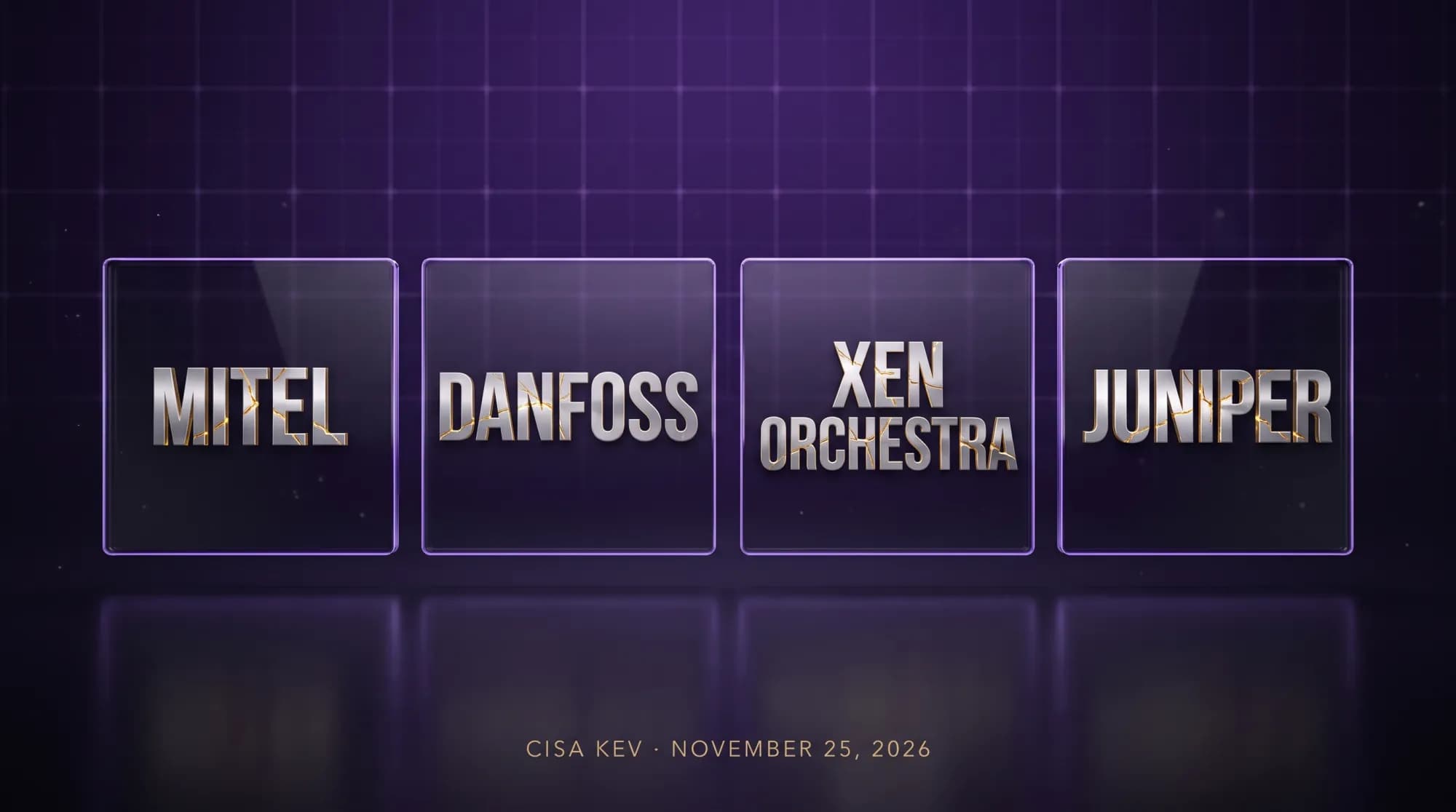
CISA added ten vulnerabilities to its Known Exploited Vulnerabilities (KEV) catalog on November 25, 2026. Five are in Mitel MiCollab, three in Danfoss AK-SM refrigeration controllers, one in Xen Orchestra and one in Juniper Session Smart Conductor. Eight have a federal due date of November 28; two have until December 9.
The batch mixes brand-new flaws with old ones. Mitel patched its five on November 16, and an intrusion report shows they were used before that. The two Danfoss path traversal and command execution bugs date from 2023. In both the Mitel and Danfoss groups, flaws with modest scores sit on the attack path next to the critical ones.
At a glance
All ten were added on November 25, 2026. Scores are the CNA's CVSS 3.1 base scores.
CVE | Product | Flaw | CVSS | Login needed | Fixed in | Federal due date |
|---|---|---|---|---|---|---|
CVE-2026-133323 | Mitel MiCollab (AWV) | Blind command injection | 10.0 | No | Patch for 10.3.0.18 | Nov 28 |
CVE-2026-133303 | Mitel MiCollab (AWV) | XML injection | 9.0 | No | Patch for 10.3.0.18 | Nov 28 |
CVE-2026-133311 | Mitel MiCollab (AWV) | Weak authentication, information access | 5.9 | No | Patch for 10.3.0.18 | Dec 9 |
CVE-2026-133324 | Mitel MiCollab (AWV) | Authentication bypass | 5.3 | No | Patch for 10.3.0.18 | Nov 28 |
CVE-2026-133275 | Mitel MiCollab (AWV) | Arbitrary file upload | 5.3 | No | Patch for 10.3.0.18 | Nov 28 |
CVE-2026-133469 | Vates Xen Orchestra | Empty-object login token | 9.8 | No | 6.9.2, 6.10.1 | Nov 28 |
CVE-2026-103406 | Juniper Session Smart Conductor | OS command injection as root | 9.8 | No | 7.0.5, 7.1.7, 7.2.3 | Nov 28 |
CVE-2025-41450 | Danfoss AK-SM 8xxA | Authentication bypass | 8.2 | No | 4.2 | Dec 9 |
CVE-2023-25914 | Danfoss AK-SM800A | Path traversal (file read) | 8.8 | Yes | 3.3 | Nov 28 |
CVE-2023-25915 | Danfoss AK-SM800A | Command execution | 9.9 | Yes | 3.3 | Nov 28 |
Mitel MiCollab: five CVEs in the AWV component
Mitel published advisory MISA-2026-0012 on November 16 for five flaws in the Audio, Web and Video Conferencing (AWV) component of MiCollab 10.3 (10.3.0.18) and earlier. None of them needs a login. Mitel warns that exploiting them together can greatly increase their impact.
CVE | Mitel ID | Flaw | Mitel CVSS |
|---|---|---|---|
CVE-2026-133323 | MTLVULN-1864 | Blind command injection | 10.0 Critical |
CVE-2026-133303 | MTLVULN-1862 | XML injection using pre-staged content | 9.0 Critical |
CVE-2026-133311 | MTLVULN-1863 | Access to sensitive information via a known random identifier | 5.9 Medium |
CVE-2026-133324 | MTLVULN-1877 | Authentication bypass | 5.3 Medium |
CVE-2026-133275 | MTLVULN-1861 | Arbitrary file upload | 5.3 Medium |
The fix is a patch for release 10.3.0.18, described in Mitel KB000129195; later releases will include it. Until you patch, Mitel's workaround is to restrict external access to AWV.
Mitel's advisory does not say the flaws were exploited. The evidence comes from Accenture's APEX Labs, which investigated an intrusion where an attacker used AWV without credentials, planted a web shell and was running commands on November 15, about a day before Mitel's patch. A second organization had connections to the same infrastructure from November 9. At the confirmed victim, the attacker reached root, used the LDAP connector's stored credentials to bind to a domain controller about 32 minutes after the first request, harvested credentials and, around 20 hours in, dumped databases and sent them out over HTTPS. APEX Labs did not name a group. It assesses the activity as likely data-theft extortion and thinks, with moderate confidence, that AI-assisted tooling drove parts of it. Its report does not say which of the five flaws were used together.
Danfoss AK-SM: three CVEs in refrigeration controllers
The Danfoss AK-SM 800A is a system manager that supervises refrigeration in supermarkets and cold storage. All three CVEs here have had fixes for a long time.
CVE | Flaw | Fixed in | Disclosed |
|---|---|---|---|
CVE-2025-41450 | Authentication bypass caused by a date-based generated password, CVSS 8.2 | AK-SM 8xxA 4.2 | March 2025, found by Tomer Goldschmidt of Claroty Team82 |
CVE-2023-25914 | Path traversal through the XML interface, letting a logged-in attacker read system files | AK-SM800A 3.3 | August 2023, reported via DIVD by HackDefense and Synacktiv |
CVE-2023-25915 | Command execution for a logged-in attacker | AK-SM800A 3.3 | August 2023, same researchers |
The 2023 pair needs a login. The 2025 bypass is a way to get one without credentials. In principle, on a controller old enough to carry all three, that combination goes from no access to command execution.
These listings land in the middle of a wider campaign. Starting October 11, attackers took over internet-exposed refrigeration controllers in French supermarkets, and France's CERT-FR named Danfoss AK-SM and AK-SC along with Copeland and Dixell xweb units. A second wave hit other European countries in early November. US agencies including CISA and the FBI then warned that attackers were changing temperatures and forcing heating or continuous defrost cycles. None of the sources we opened ties these three CVEs to those attacks directly.
One more caution. On November 11, Midnight Blue disclosed six unpatched flaws in the AK-SM800A that need no login, affecting firmware up to and including 5.3.2. They have no CVEs and no fix yet, and Danfoss's newest release, 5.4.0, is not confirmed to address them. So installing the fixes for the three KEV entries is necessary but does not make these controllers safe to leave on the internet.
Xen Orchestra: CVE-2026-133469
Xen Orchestra (XO) is Vates' web console for managing XCP-ng and Xen virtualization pools. Vates published advisory VSA-2026-062 on November 10 and says the flaw is actively exploited. A crafted authentication cookie is parsed into an empty object, and the token lookup treats it as "no filter" and returns the first unexpired token. The attacker is then logged in as that token's owner, often an admin. The CVE record scores it 9.8 Critical.
Package | Fixed in |
|---|---|
Xen Orchestra (stable / latest) | 6.9.2 / 6.10.1 |
xo-server (stable / latest) | 5.211.2 / 5.213.1 |
Xen Orchestra Appliance | Affected; update to a fixed release |
Installs from source | Update to the latest master |
Vates notes that an admin session in XO can lead to code execution on managed pools and full root takeover of an XCP-ng host, as a consequence of controlling XO rather than a separate root flaw. Its advisory lists attacker infrastructure, including an IP address and a Tor onion service, and host-level indicators. If compromise is confirmed, Vates recommends rotating every password and secret XO uses, including root, pool, backup and mail credentials, and doing a full reinstall, because cleanup may not remove all backdoors. Credit: Filip Magic and Christoffer Olsen of TDC NET Security.
Juniper Session Smart Conductor: CVE-2026-103406
Session Smart Conductor is the management platform for Juniper's Session Smart Router SD-WAN fleet. Juniper disclosed CVE-2026-103406 on October 28 as part of bulletin JSA112183. The AutomatedProvisioner, which handles key management for managed routers, does not sanitize salt minion IDs, so a remote attacker with no login can send a crafted ID and run commands as root. Juniper found it internally and scores it 9.8 Critical.
Affected Conductor releases | Fixed in |
|---|---|
Before 7.0.5 | 7.0.5 |
7.1.0 to before 7.1.7 | 7.1.7 |
7.2.0 to before 7.2.3 | 7.2.3 |
This CVE affects Conductor only, not the routers themselves, although the same bulletin fixed other flaws in both. Juniper lists no workaround. The CVE record now says at least one case of malicious exploitation has been reported to the Juniper SIRT, with no further detail. Because Conductor manages the router fleet, a compromised Conductor can put every managed site at risk.
Low scores, same deadline
Sort this batch by CVSS and three Mitel flaws and the Danfoss bypass land near the bottom. CISA still listed them, and in both groups the lower-rated flaws are part of the attack path rather than side issues.
Group | Lower-rated flaws | Score | Higher-rated flaws | Score | How they connect |
|---|---|---|---|---|---|
Mitel MiCollab | Authentication bypass, information access, file upload | 5.3 to 5.9 | Command injection, XML injection | 9.0 to 10.0 | All five sit in the same unauthenticated AWV component, and Mitel says using them together greatly increases impact |
Danfoss AK-SM | Date-based password bypass (CVE-2025-41450) | 8.2 | File read and command execution (CVE-2023-25914, CVE-2023-25915) | 8.8 and 9.9 | The 2023 pair needs a login; the bypass is a way to get one |
CISA gave the Mitel 5.3 bypass and file upload the same three-day deadline as the 10.0 command injection. Only the 5.9 information-access flaw and the Danfoss bypass, both marked not automatable with partial impact, got until December 9.
The practical rule: when a KEV batch lists several flaws in one product, patch the whole set, and do not deprioritize a Medium because of its score. In a chain, the flaw that removes authentication or stages content can matter as much as the one that runs code.
Reading them on VulnTracker
All ten show the KEV banner and SSVC Exploitation "Active". The scores VulnTracker shows do not always match the CNA's.
CVE | VulnTracker score | CNA score | EPSS | SSVC Automatable / impact | Fix badge |
|---|---|---|---|---|---|
CVE-2026-133323 (Mitel) | 9.8 | 10.0 | 3% | Yes / Total | No fix recorded |
CVE-2026-133303 (Mitel) | 9.8 | 9.0 | 0.5% | No / Total | No fix recorded |
CVE-2026-133311 (Mitel) | 5.9 | 5.9 | 0.4% | No / Partial | None |
CVE-2026-133324 (Mitel) | 5.3 | 5.3 | 0.4% | Yes / Partial | None |
CVE-2026-133275 (Mitel) | 5.3 | 5.3 | 0.3% | Yes / Partial | None |
CVE-2026-133469 (Xen Orchestra) | 9.8 | 9.8 | 1% | Yes / Total | Fix available |
CVE-2026-103406 (Juniper) | 9.8 | 9.8 | 0.9% | Yes / Total | None |
CVE-2025-41450 (Danfoss) | 7.5 | 8.2 | 0.5% | No / Partial | None |
CVE-2023-25914 (Danfoss) | 8.8 | 8.8 | 1% | No / Total | None |
CVE-2023-25915 (Danfoss) | 8.8 | 9.9 | 1% | No / Total | None |
Data notes:
- Mitel fix badges. Two Mitel entries say "No fix recorded" because the CVE records list no fixed version. Mitel does provide a patch for 10.3.0.18 (KB000129195).
- Score gaps. In these cases VulnTracker's list shows a score from a different source than the CNA. The largest gaps are Danfoss CVE-2023-25915 (8.8 against DIVD's 9.9) and Mitel CVE-2026-133303 (9.8 against Mitel's 9.0).
- Stale CVE records for Danfoss 2023. The two DIVD records still carry an old CISA SSVC entry of Exploitation "none" and no KEV data. VulnTracker correctly shows them as KEV-listed and active.
- Deadlines and SSVC. Here, the two entries with a December 9 deadline are both not automatable with partial impact. Not automatable entries with total impact, such as the Danfoss 2023 pair, got three days. Last week, Puppet and LiteLLM, also not automatable with total impact, got two weeks, so the pattern is not consistent across batches.
- EPSS is low across the board. No entry is above 3%, even though all ten are confirmed exploited. On KEV entries, the KEV status is the stronger signal.
What to do
- Mitel MiCollab: image first, then patch. Accenture recommends taking forensic images of MiCollab and Border Gateway servers before patching, because patching can wipe evidence. Then apply Mitel's patch for 10.3.0.18 per KB000129195, and restrict external access to AWV until it is in.
- Treat a compromised MiCollab as an Active Directory problem. Reset the LDAP connector account and Kerberoastable service accounts, and hunt in upstream proxy and WAF logs, since local logs may have been cleared.
- Xen Orchestra: update to 6.9.2 or 6.10.1 (xo-server 5.211.2 or 5.213.1), keep XO on a management network, and check for Vates' indicators. If you find them, rotate every secret XO holds and plan a reinstall.
- Juniper: upgrade Session Smart Conductor to 7.0.5, 7.1.7, 7.2.3 or later, restrict who can reach it, and review managed routers for unexpected changes.
- Danfoss: take the controllers off the internet. Install the latest AK-SM 800A release, which covers all three KEV entries, but do not rely on it alone given the six unpatched flaws reported this month. Use a VPN for remote access, including any contractor 4G or 5G modems, change default passwords and check setpoints, defrost schedules and alarms for tampering.
- Patch whole sets, not single CVEs. Where a batch lists several flaws in one product, close all of them.
Takeaway
Ten KEV entries from four vendors, and the lesson repeats across them: an attacker rarely needs just one flaw. MiCollab's AWV flaws were used before a patch existed, the Danfoss bypass pairs with bugs from 2023, and in Xen Orchestra and Juniper Conductor a single flaw in a management console reaches everything that console controls.
To see whether any of these products are in your environment, check them against your stack on VulnTracker and follow their status as vendors and researchers publish more.
References
- Mitel Product Security Advisory MISA-2026-0012
- Accenture APEX Labs: MiCollab exploitation
- CVE-2026-133323 record, CVE-2026-133303, CVE-2026-133311, CVE-2026-133324, CVE-2026-133275, CVE Program API
- Vates security advisory VSA-2026-062
- CVE-2026-133469 record, CVE Program API
- CVE-2026-103406 record, CVE Program API
- Juniper security bulletin JSA112183
- Danfoss security advisory DSA-2025-03-01
- CVE-2025-41450 record, CVE-2023-25914, CVE-2023-25915, CVE Program API
- DIVD case DIVD-2023-00025
- THN: Six unpatched Danfoss refrigeration controller flaws
- Help Net Security: US agencies warn of attacks on refrigeration systems
Related reading
CISA Adds AntiCsrf and Optimizely Flaws to KEV: Two Exploited Bugs With No Patch to Apply
CISA gave agencies until November 27 to act on two exploited flaws with no patch to install: a deserialization bug in the abandoned Idunno AntiCsrf library, and a signup flaw Optimizely already fixed after attackers used it to plant malicious scripts on customer sites.
CISA Adds N-able MailAssure and MONAI Label Flaws to KEV, One Found by AI Agents
CISA gave federal agencies until November 26 to address two exploited flaws: an SSRF behind N-able's MailAssure cloud incident, and a path traversal in MONAI Label that AWS says AI agents found and exploited on their own. Here is who has to act and how.
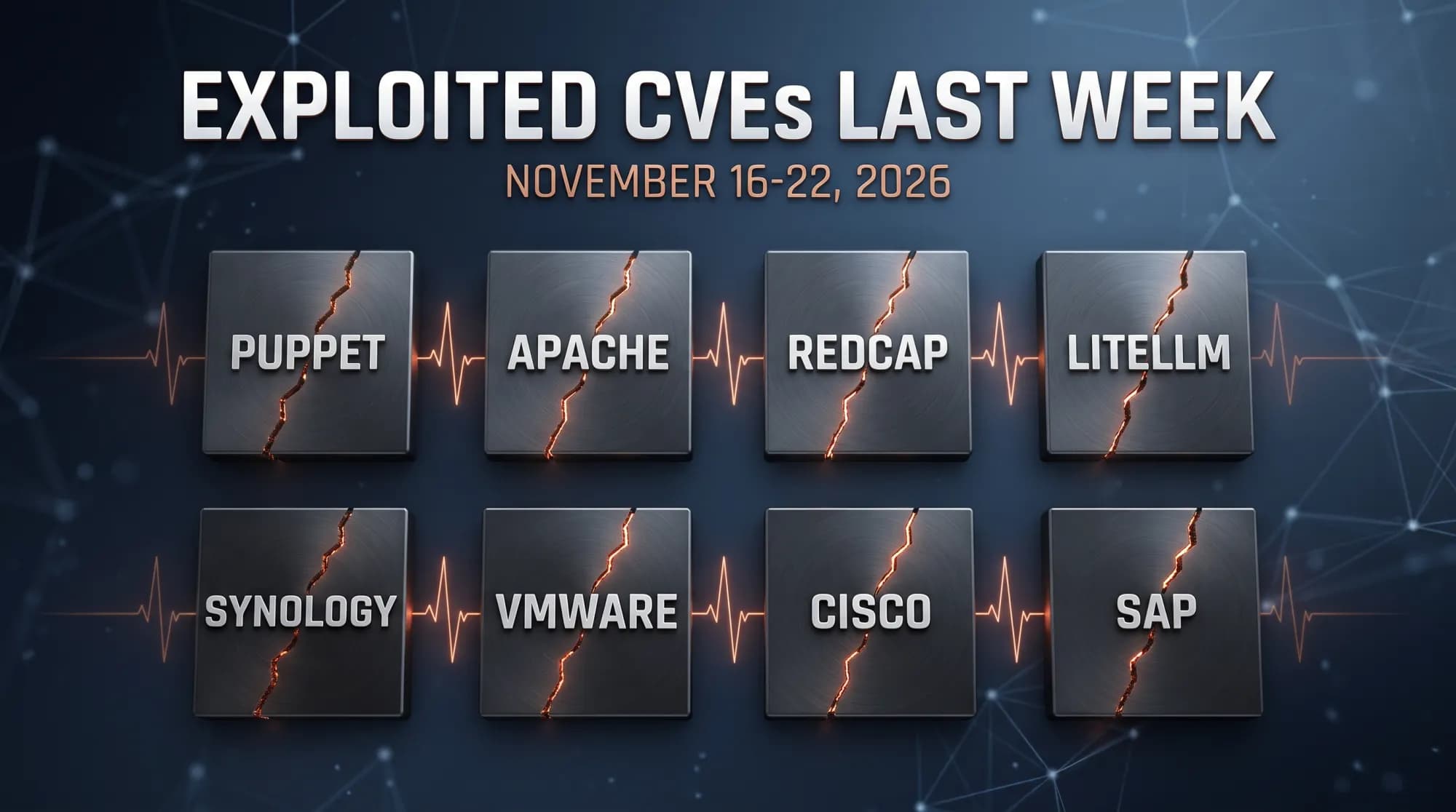
Exploited CVEs Last Week: November 16-22, 2026
CISA added nine exploited flaws to KEV last week, from Puppet and Apache Axis to vCenter and Cisco Expressway. Every automatable one got a three-day federal deadline, while the two that are not got two weeks. Here are the fixes and what to check.