
Exploited CVEs Last Week: November 16-22, 2026
CISA added nine exploited flaws to KEV last week, from Puppet and Apache Axis to vCenter and Cisco Expressway. Every automatable one got a three-day federal deadline, while the two that are not got two weeks. Here are the fixes and what to check.
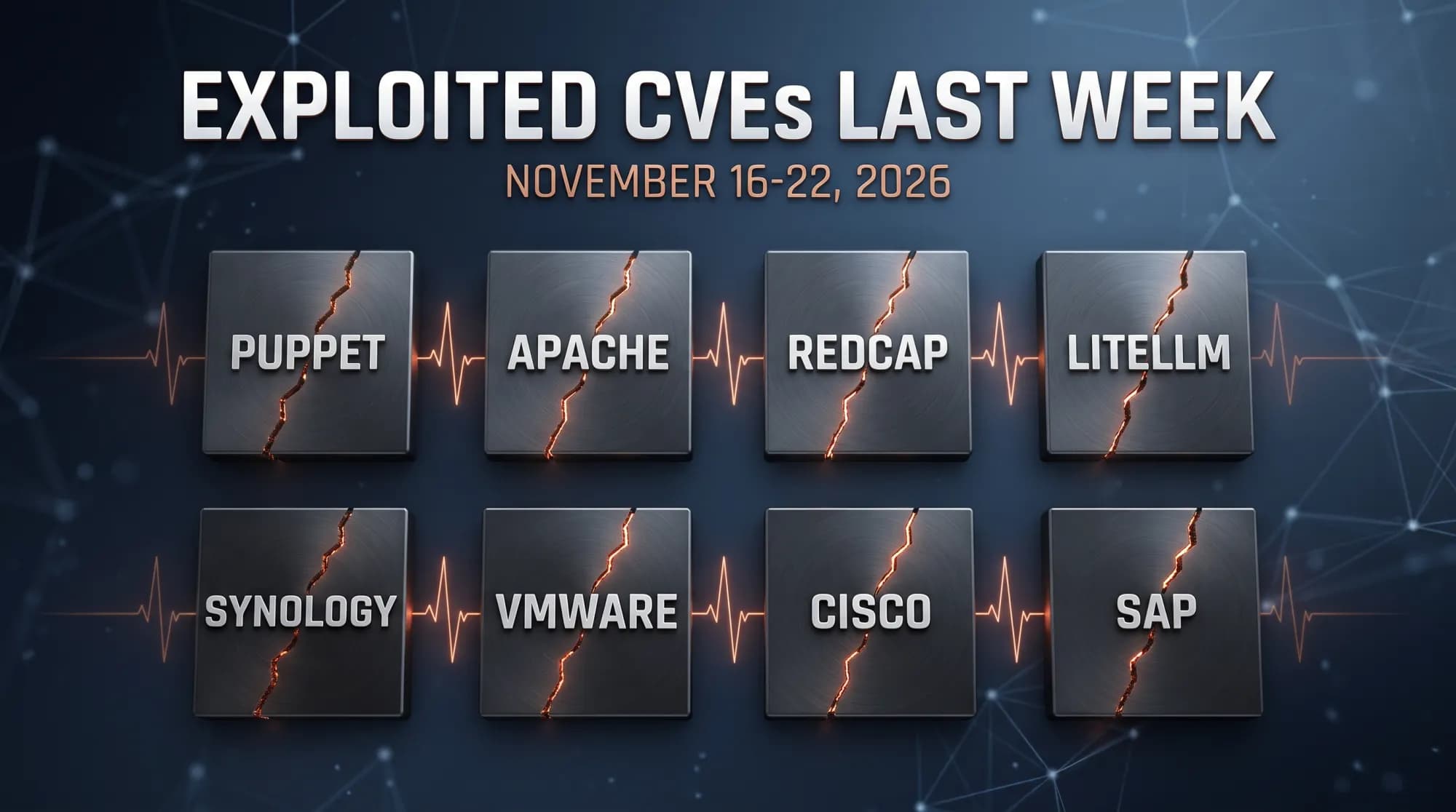
CISA added nine vulnerabilities to its Known Exploited Vulnerabilities (KEV) catalog between November 16 and 22, 2026, in three waves: one on November 17, four on November 18 and four on November 20. Eight are rated Critical or High. They span configuration management (Puppet), a dead SOAP library (Apache Axis 1.x), research survey software (REDCap), an AI gateway (LiteLLM), NAS devices (Synology), virtualization (VMware vCenter), a blog server (Apache Roller), a perimeter gateway (Cisco Expressway) and an enterprise portal (SAP NetWeaver).
Federal deadlines under BOD 26-04 ran from three days to two weeks. Three of them, for Axis, REDCap and Synology, have already passed. Four more fall today, November 23.
At a glance
Sorted by the date each CVE was added to KEV.
Added | CVE | Product | Flaw | CVSS | Federal due date |
|---|---|---|---|---|---|
Nov 17 | CVE-2026-115731 | Puppet / Puppet Enterprise | Report deserialization code execution | 9.4 (CVSS 4.0, Perforce) | Dec 1 |
Nov 18 | CVE-2026-90436 | Apache Axis 1.x (end of life) | Unsafe reflection via SOAP fault | 9.8 (CISA-ADP) | Nov 21 |
Nov 18 | CVE-2026-90817 | Vanderbilt REDCap | Code injection via survey routing and Data Import | 9.8 | Nov 21 |
Nov 18 | CVE-2026-40217 | BerriAI LiteLLM | Code execution via bytecode rewriting | 8.8 | Dec 2 |
Nov 18 | CVE-2024-10441 | Synology DSM and BeeStation OS | Output encoding flaw in the system plugin daemon | 9.8 | Nov 21 |
Nov 20 | CVE-2026-123890 | VMware vCenter | Authentication bypass | 9.8 | Nov 23 |
Nov 20 | CVE-2026-129448 | Apache Roller | Unauthenticated deserialization in XML-RPC | 9.8 | Nov 23 |
Nov 20 | CVE-2026-76466 | Cisco Expressway | Root command execution on clustered devices | 9.8 | Nov 23 |
Nov 20 | CVE-2025-42884 | SAP NetWeaver Enterprise Portal | JNDI injection | 6.5 | Nov 23 |
November 17: Puppet
CVE-2026-115731, Puppet Server report deserialization. Perforce fixed this on November 3. Puppet's report-processing code deserializes untrusted data, so any client holding a CA-signed agent certificate can run code on the Puppet Server as its service user. If the CA autosigns requests without strong verification, an unauthenticated attacker can get such a certificate. That makes autosigning settings the first thing to check.
Product | Affected | Fixed |
|---|---|---|
Puppet Enterprise | 2023.8.0 to before 2023.8.13; 2025.0.0 to before 2025.12.1; 2026.0.0 to before 2026.0.1 | 2023.8.13, 2025.12.1, 2026.0.1 |
Puppet Core | 8.x before 8.22.2; 9.0.0 before 9.1.3 | 8.22.2, 9.1.3 |
OpenVox | Affected | Agent 9.3.0 / 8.32.0, Server 9.2.0 / 8.18.0 |
Restart Puppet Server after upgrading so the fixed code is loaded. Public detail on the attacks is thin. THN reported no technical details, only a Reddit user who said on November 4 that they had traced an intrusion through this flaw after finding a misconfigured CA. Neodyme AG, whose researcher found the bug, warns that code execution on a Puppet server can expose the CA signing keys. Credit goes to Alain Rödel of Neodyme AG.
November 18: Apache Axis, REDCap, LiteLLM, Synology
CVE-2026-90436, Apache Axis 1.x unsafe reflection. When Axis 1.x parses an inbound SOAP fault, it loads the class named in the message and can call its String constructor, before any service-level authentication runs. With a suitable class on the classpath, that becomes remote code execution. Axis 1 is end of life and Apache does not plan a 1.x release. The options are migrating to another SOAP engine such as Axis 2/Java, or building Axis with the upstream fix commit. Axis often sits inside other products. According to THN, Rapid7 saw it exploited through Atlassian Confluence Data Center with the Remote API enabled, followed by credential theft, and it has also been tied to cryptominer deployments on N-able N-central. Credit: José Apari-Pantigozo of OKIOK.
CVE-2026-90817, REDCap code injection. REDCap is research survey software from Vanderbilt University. A crafted request can reach an unintended controller route from a public survey and pass a file path or stream parameter during Data Import, which leads to code execution. No login is needed, but the attacker must know a valid public survey hash. Fixed in 16.0.49 LTS, 17.3.10 LTS and 17.4.4. THN reports, citing Safe Security, that attackers used it to drop a web shell and an XMRig miner disguised as syslog-ng. Credit: Ryan Wincey of Securifera.
CVE-2026-40217, LiteLLM bytecode rewriting. LiteLLM through the April 8, 2026 build lets a remote attacker run code through the /guardrails/test_custom_code endpoint. It needs a low-privilege credential, which is why it scores 8.8. VulnTracker infers 1.83.10 as the first fixed LiteLLM version; the CVE record names no fixed LiteLLM release. Red Hat has fixed builds for Ansible Automation Platform 2.6 and OpenShift AI 3.3. According to THN, Google Threat Intelligence Group tied the exploitation to LLMjacking campaigns that turned limited inference keys into full admin credentials.
CVE-2024-10441, Synology DSM and BeeStation OS. An output encoding flaw in the system plugin daemon gives remote code execution with no login. Synology fixed it in late 2024 after Pwn2Own; the fixed builds are DSM 7.1.1-42962-7, 7.2-64570-4, 7.2.1-69057-6 and 7.2.2-72806-1, and BeeStation OS 1.1-65374. THN reports that Synology said earlier this month the flaw was used in ransomware attacks with C3RB3R. Synology's own advisory, last updated in March 2025, does not mention exploitation. Credit: Ryan Emmons.
November 20: VMware vCenter, Apache Roller, Cisco Expressway, SAP
CVE-2026-123890, vCenter authentication bypass. A flaw in the VMware Directory Service lets anyone with network access to vCenter skip authentication. Fixed in vCenter 9.1.1.0200, 9.0.2.0200, 8.0 U3m and VCF 5.2.5; Telco Cloud users follow KB463116, and vCenter 7.0 needs Broadcom Support. Google Threat Intelligence Group and Mandiant tie it to ARMORY CASTLE, a suspected PRC-nexus espionage actor that used it as a zero-day in early September 2026.
CVE-2026-129448, Apache Roller XML-RPC deserialization. Roller 4.0.0 up to 6.1.5 deserializes XML-RPC extension types before checking the caller. Upgrade to 6.1.6, or set enabledForExtensions to false or remove the /roller-services/xmlrpc mapping; the admin UI toggle does not protect older versions. Apache states it is being actively exploited and has published no further detail.
CVE-2026-76466, Cisco Expressway root command execution. Clustered Expressway-C and Expressway-E devices on X15.5.3 and earlier let an unauthenticated attacker run commands as root. Upgrade to X15.5.20; X14 and earlier must migrate. F6 reported the first observed exploitation against a Russian company after a public proof-of-concept, with indicators in erlang.log.
CVE-2025-42884, SAP NetWeaver Enterprise Portal JNDI injection. Fixed on SAP's November 2025 Patch Day through SAP Note 3660969, for EP-BASIS and EP-RUNTIME 7.50. It is rated 6.5 Medium. No public report on the attacks has been found.
The deadlines line up with Automatable
This week's data shows one clear pattern. Every CVE that SSVC marks as automatable got three days. The two marked not automatable got two weeks, even though both give total control.
CVE | SSVC Automatable | SSVC Technical impact | Days to federal due date |
|---|---|---|---|
CVE-2026-90436 (Axis) | Yes | Total | 3 |
CVE-2026-90817 (REDCap) | Yes | Total | 3 |
CVE-2024-10441 (Synology) | Yes | Total | 3 |
CVE-2026-123890 (vCenter) | Yes | Total | 3 |
CVE-2026-129448 (Roller) | Yes | Total | 3 |
CVE-2026-76466 (Expressway) | Yes | Total | 3 |
CVE-2025-42884 (SAP) | Yes | Partial | 3 |
CVE-2026-115731 (Puppet) | No | Total | 14 |
CVE-2026-40217 (LiteLLM) | No | Total | 14 |
The split makes sense on its face. Puppet needs a CA-signed agent certificate, and LiteLLM needs a low-privilege key, so neither can be sprayed across the internet as easily. Even the SAP Medium, with only partial impact, got three days, and it is marked automatable.
Two cautions. Nine CVEs is one week of data, not a rule. And this pattern does not match some published summaries of BOD 26-04, which put every KEV entry with total impact on the three-day track. We could not read the directive text itself, so check it before you build policy on this. For your own queue, the practical reading holds either way: an exploited flaw that can be automated deserves the same-week treatment.
Reading them on VulnTracker
All nine show the KEV banner, SSVC Exploitation "Active" and status Analyzed. EPSS is where they differ most.
CVE | EPSS | Exploits tab | Remediation guide |
|---|---|---|---|
CVE-2026-40217 (LiteLLM) | 78.0% | 1 | Not yet |
CVE-2026-90817 (REDCap) | 34.3% | 7 | Yes |
CVE-2026-129448 (Roller) | 5.5% | 3 | Yes |
CVE-2026-90436 (Axis) | 3.8% | 4 | Yes |
CVE-2026-123890 (vCenter) | 3.5% | 9 | Yes |
CVE-2024-10441 (Synology) | 3.1% | 3 | Not yet |
CVE-2026-76466 (Expressway) | 2.2% | 5 | Yes |
CVE-2026-115731 (Puppet) | 1.2% | 1 | Yes |
CVE-2025-42884 (SAP) | 0.7% | None | Not yet |
Data notes:
- EPSS and deadlines point different ways. LiteLLM has the highest EPSS of the week and one of the two longest federal deadlines. EPSS forecasts exploitation activity; BOD 26-04 timing follows other factors. Read both.
- EPSS moved fast after listing. On November 21, VulnTracker showed vCenter at 0.8%, Roller at 1% and Expressway at 0.4%. Two days later they are several times higher.
- Puppet scores. Perforce gives 9.4 under CVSS 4.0. VulnTracker's list view shows 9.9, which is NVD's CVSS 3.1 score.
- Axis score. The Apache CVE record has only a text rating of "critical". The 9.8 comes from CISA's enrichment.
- LiteLLM fix version. VulnTracker infers 1.83.10 from the affected range. The CVE record does not name a fixed LiteLLM release, so confirm against the LiteLLM project before relying on it.
What to do
- Inventory first, including what is embedded. Axis 1.x hides inside other products, Confluence among them. LiteLLM may sit inside AI platforms such as Red Hat's.
- Clear the three-day group. Patch vCenter, Roller, Expressway, Synology, REDCap and SAP now. For Axis 1.x, plan a migration or a patched build, and turn off Confluence's Remote API if you do not need it.
- Do not let the two-week group slide. Upgrade Puppet and restart Puppet Server, and review CA autosigning. Upgrade LiteLLM, or apply Red Hat's fixed builds, and rotate inference and admin keys.
- Hunt where indicators exist. GTIG published indicators for vCenter and ESXi, F6 for Expressway. For the rest, look at exposure and at unusual processes on those hosts, such as miners.
- Check for compromise, not just version numbers. Several of these were exploited before or soon after their fixes. A patched host can still carry a web shell, a miner or stolen keys.
Takeaway
Nine KEV additions in one week, across nine very different products, with deadlines that line up with whether the attack can be automated. If you track only CVSS, you would have ranked the SAP Medium last and missed that it shares the three-day track with the Critical ones.
To see which of last week's nine sit in your own stack, check them against your products on VulnTracker and follow their status as vendors publish more.
References
- CVE-2026-115731 record, CVE Program API
- THN: Puppet flaw added to KEV
- CVE-2026-90436 record, CVE Program API
- CVE-2026-90817 record, CVE Program API
- CVE-2026-40217 record, CVE Program API
- CVE-2024-10441 record, CVE Program API
- Synology-SA-24:20
- THN: CISA warns of four exploited flaws (November 18 additions)
- Broadcom security advisory for CVE-2026-123890
- Google Threat Intelligence: ARMORY CASTLE exploits vSphere
- CVE-2026-129448 record, CVE Program API
- Cisco Security Advisory cisco-sa-vcs-static-cred-hr7EWZ8t
- F6 press release on CVE-2026-76466 (in Russian)
- CVE-2025-42884 record, CVE Program API
- SAP Security Patch Day bulletin 2025
- Tenable: CISA BOD 26-04 FAQ
Related reading
Exploited CVEs Nov 9-15, 2026: Microsoft, Chrome, Barracuda, Check Point, OpenSSH
Twelve CVEs were added to CISA's KEV catalog from Nov 9 to 15, 2026, including Outlook, Chrome, Barracuda, Check Point and OpenSSH. All twelve are marked exploited, yet eight have an EPSS of 2.2% or lower. Fixes, due dates and what to patch first.
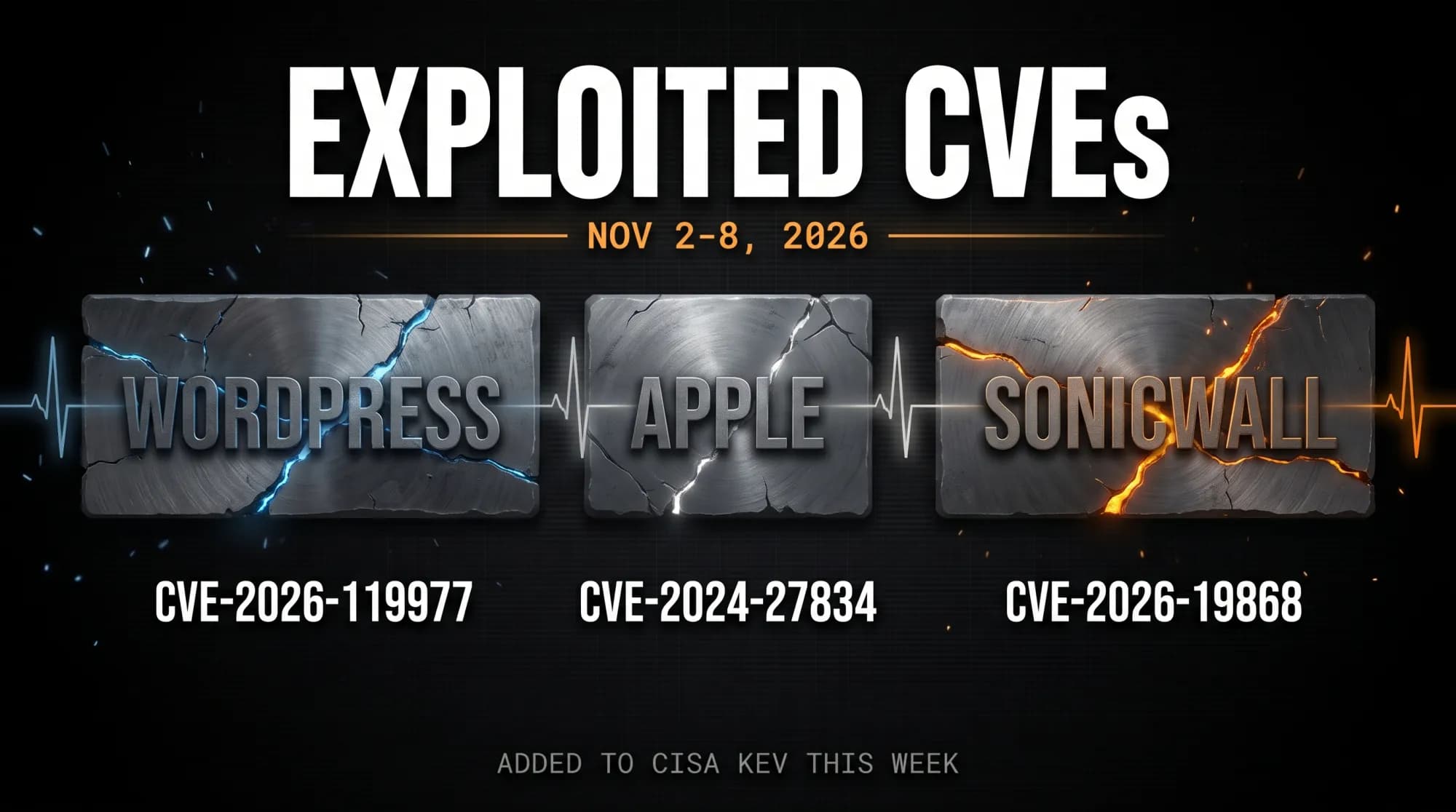
Exploited CVEs Nov 2-8, 2026: WordPress, Apple, SonicWall
Three exploited CVEs entered CISA KEV last week: WordPress Core, Apple WebKit and SonicWall SonicOS. Each had a vendor fix before the listing, from six days to 905 days earlier. Here is the week in one place, with deadlines and what to patch first.
Exploited CVEs Oct 26-Nov 1, 2026
Nine CVEs from eight vendors joined CISA KEV last week, from a 2.7 VMware logging flaw to a CVSS 10.0 GitLab bug. Same SSVC tags got three-day and 14-day deadlines, so here is what to patch first and why.