
CISA Adds Four Exploited Flaws to KEV: vCenter, Apache Roller, Cisco Expressway and SAP NetWeaver
CISA added flaws in VMware vCenter, Apache Roller, Cisco Expressway and SAP NetWeaver to KEV with a three-day federal deadline. All four have fixes, but the public evidence behind each listing ranges from a full threat report to nothing at all.
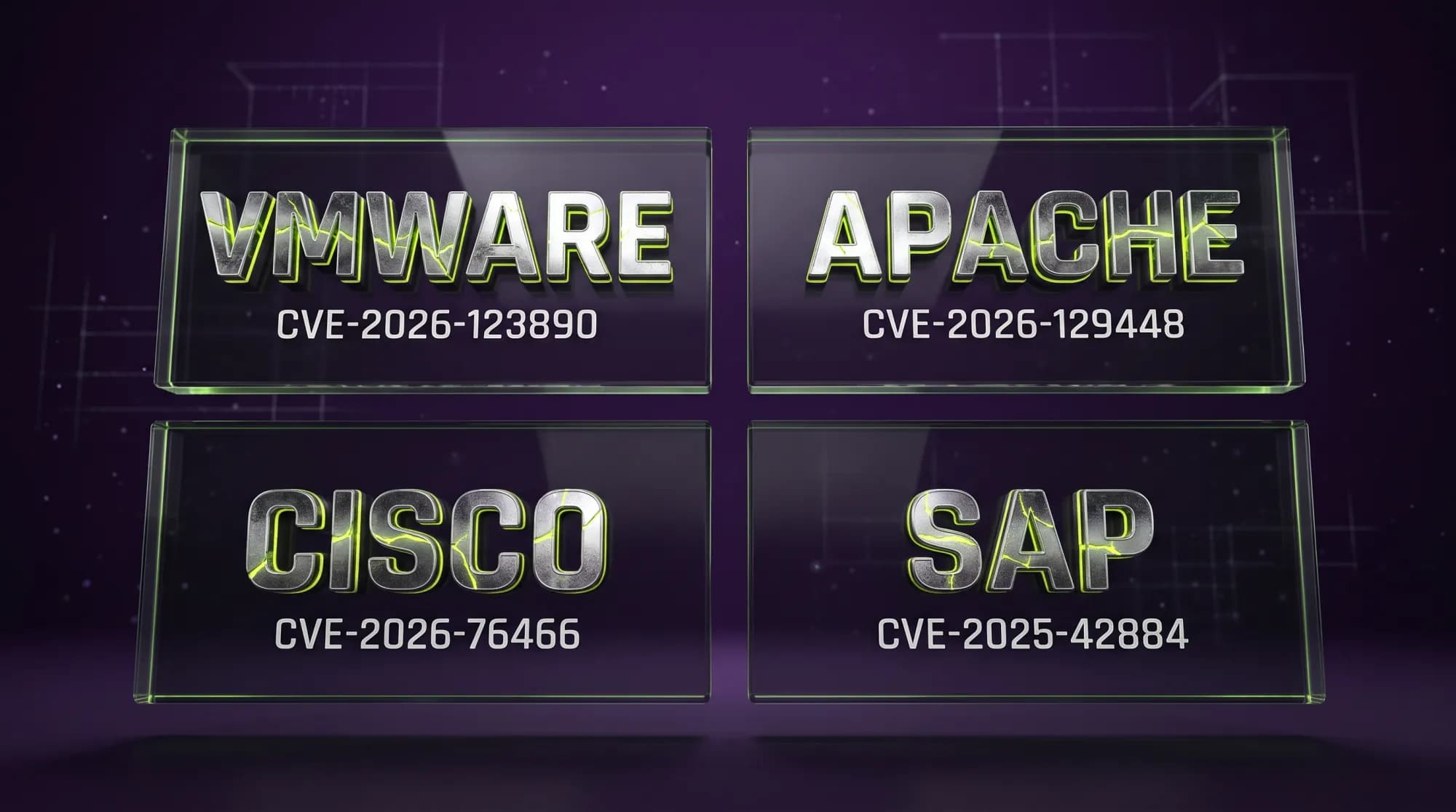
CISA added four vulnerabilities to its Known Exploited Vulnerabilities (KEV) catalog on November 20, 2026, and gave federal civilian agencies until November 23 to act. The four hit very different parts of an estate: VMware vCenter, Apache Roller, Cisco Expressway and SAP NetWeaver Enterprise Portal. Three are rated 9.8 Critical. The fourth, in SAP, is a 6.5 Medium from November 2025.
The three-day window comes from Binding Operational Directive 26-04, which CISA issued on June 10, 2026 to replace BOD 22-01 and BOD 19-02. Instead of a fixed deadline for every KEV entry, the directive sets remediation windows from a risk model, and the most dangerous tier gets as few as three days plus forensic triage. All four entries in this batch got the three-day deadline.
Fixes exist for all four. What differs is how much the public knows about the attacks behind each listing, and that is worth reading before you rank them.
The four CVEs at a glance
All four were added on November 20, 2026, with a federal due date of November 23, 2026.
CVE | Product | Flaw | CVSS | Fixed in |
|---|---|---|---|---|
CVE-2026-123890 | VMware vCenter (Broadcom) | Authentication bypass in VMware Directory Service | 9.8 Critical | 9.1.1.0200, 9.0.2.0200, 8.0 U3m, VCF 5.2.5 |
CVE-2026-129448 | Apache Roller | Unauthenticated deserialization in the XML-RPC endpoint | 9.8 Critical | 6.1.6 |
CVE-2026-76466 | Cisco Expressway | Root command execution on clustered devices via the database service | 9.8 Critical | X15.5.20 |
CVE-2025-42884 | SAP NetWeaver Enterprise Portal | JNDI injection | 6.5 Medium | SAP Note 3660969 |
VMware vCenter: CVE-2026-123890
Broadcom disclosed CVE-2026-123890 on November 19 as an authentication bypass in the VMware Directory Service inside vCenter. Anyone with network access to vCenter can skip authentication and get unauthorized access, with no privileges or user interaction needed. Broadcom lists no workaround and credits Mandiant with the report.
Product | Affected | Fixed version |
|---|---|---|
VCF / vSphere Foundation (vCenter 9.1.x) | 9.1.x.x | 9.1.1.0200 |
VCF / vSphere Foundation (vCenter 9.0.x) | 9.0.x.x | 9.0.2.0200 |
VMware vCenter | 8.0 | 8.0 U3m |
VMware vCenter | 7.0 | Contact Broadcom Support (extended support required) |
VMware Cloud Foundation | 5.x | 5.2.5 |
Telco Cloud Platform / Telco Cloud Infrastructure | 3.0 to 5.2 / 3.0 | See KB463116 |
The exploitation story comes from Google Threat Intelligence Group and Mandiant, published the same day. They tie it to ARMORY CASTLE, formerly UNC5221, which they assess as a suspected PRC-nexus espionage actor. According to GTIG, the group got in through a BeyondTrust Remote Support zero-day (CVE-2026-102764), moved to vCenter, and exploited CVE-2026-123890 as a zero-day in early September 2026, more than two months before the patch. GTIG names a set of custom tools, including webshells, a modified SSH backdoor and a Slack-based backdoor, and does not name victims.
Apache Roller: CVE-2026-129448
Apache published CVE-2026-129448 on November 17 for Roller, its Java blogging server. The XML-RPC endpoint accepts vendor extension types and deserializes them before it checks who is asking, which gives an unauthenticated attacker code execution. Credit goes to n0mi1k (finder) and Matt Raible (reporter).
The record says it is the same flaw as CVE-2026-82384, which named only Roller 6.1.5. The new CVE widens the range back to 4.0.0. The description says 4.0.0 through 6.1.4, while the version data marks everything before 6.1.5 as affected, so treat 6.1.5 as vulnerable too.
Affected | Fix | If you cannot upgrade yet |
|---|---|---|
Roller 4.0.0 up to 6.1.5 | 6.1.6 or later | Set |
Apache warns that turning off XML-RPC in the admin UI does not protect older versions. On exploitation, the record carries Apache's own one-line statement that the issue is being actively exploited. Apache has not said who is behind it or how it is used.
Cisco Expressway: CVE-2026-76466
Cisco patched CVE-2026-76466 on October 21. It lets an unauthenticated remote attacker run commands as root on Expressway-C and Expressway-E devices that are configured in a cluster. Cisco cites persistent cookies and client certificates that go unchecked when TLS Verify Mode is enabled for clustering.
Affected | Fix |
|---|---|
X15.5.3 and earlier (clustered) | X15.5.20 |
X14 and earlier | Migrate to a fixed release |
The exploitation evidence comes from Russian security company F6, in a press release dated November 18. F6 says attackers compromised two internet-facing Expressway devices running X15.5.3 at a Russian company shortly after a public proof-of-concept appeared, then reached two more cluster nodes on the internal network. F6 also published indicators: two IP addresses, an erlang.log entry naming [email protected], and Python scripts staged under /mnt/harddisk/. Where patching must wait, F6 suggests allowing TCP 4371 and 4372 only from trusted cluster nodes. Cisco itself lists no workaround.
SAP NetWeaver Enterprise Portal: CVE-2025-42884
The oldest entry in the batch was fixed on SAP's November 2025 Security Patch Day, a year before it reached KEV. It is a JNDI injection flaw: an unauthenticated attacker can inject JNDI environment properties or supply a URL used in a JNDI lookup, reaching a JNDI provider the server should not talk to. SAP scores it 6.5 Medium because the impact is limited disclosure or modification of server information, with no effect on availability.
Affected | Fix |
|---|---|
SAP NetWeaver Enterprise Portal, EP-BASIS 7.50 and EP-RUNTIME 7.50 | SAP Note 3660969 (SAP login required) |
CISA's SSVC entry for this CVE now reads Exploitation active, Automatable yes, Technical impact partial. Beyond the KEV listing itself, there is no public account of the attacks. THN noted that it found no public reports documenting exploitation of this CVE.
Four entries, four levels of evidence
A KEV listing tells you CISA has evidence of exploitation. It does not tell you what that evidence is, and in this batch the public record ranges from a full threat report to nothing at all.
CVE | Who says it is exploited | What is public |
|---|---|---|
CVE-2026-123890 (vCenter) | Google Threat Intelligence Group and Mandiant | Named actor, timeline back to September, tool names, IOCs and YARA rules |
CVE-2026-76466 (Cisco Expressway) | F6 | One victim, the version, the attack path, IOCs and a port mitigation |
CVE-2026-129448 (Apache Roller) | Apache, in the CVE record | One sentence; no actor, method or indicators |
CVE-2025-42884 (SAP) | CISA, through the KEV listing | No public report found |
This matters for two jobs. For patching, it changes nothing. All four are on KEV with the same deadline, and a missing report is not evidence that attacks are rare. For hunting, it changes a lot. On vCenter and Expressway you have indicators to search for today. On Roller and SAP you are working without them, so the useful checks are exposure (is the XML-RPC endpoint or the portal reachable from the internet?) and general signs of compromise on those hosts.
The SAP entry shows one more pattern. A Medium score from a year ago is easy to leave in the backlog, and this listing is a reason to check whether that happened.
Reading them on VulnTracker
All four now show the KEV banner, SSVC Exploitation "Active" and status Analyzed. The fields worth comparing are below.
CVE | CVSS | EPSS | SSVC | CWE | Exploits tab | Remediation |
|---|---|---|---|---|---|---|
CVE-2026-123890 | 9.8 Critical | 0.8% | Active · Automatable · Total impact | CWE-288 | 6 entries | Fix available |
CVE-2026-129448 | 9.8 Critical | 1% (1.2% on the CVE page) | Active · Automatable · Total impact | CWE-502 | 2 entries | Fix available |
CVE-2026-76466 | 9.8 Critical | 0.4% | Active · Automatable · Total impact | CWE-798 | 3 entries | Fix available |
CVE-2025-42884 | 6.5 Medium | 0.3% | Active · Automatable · Partial impact | CWE-943 | None | No guide yet |
Data notes:
- EPSS stays low after a KEV listing. None of the four is above about 1%. EPSS is a forecast of exploitation over the next 30 days, so it trails confirmed exploitation. On a KEV entry, the KEV status is the stronger signal.
- Roller fix version. VulnTracker's remediation panel flags its own recorded fix row (6.1.5) as conflicting with Apache's statement and uses 6.1.6, matching Apache.
- Expressway fix version. The panel shows X15.5.20 as an inferred fix and says the Cisco advisory names no version in its data. Cisco's advisory does name X15.5.20 as the first fixed release.
- vCenter 7.0. VulnTracker lists 7.0 as affected with no fix. Broadcom's advisory confirms there is no public fix and points 7.0 customers to Broadcom Support under extended support.
- SAP. The Remediation block has no guide yet. SAP Note 3660969 is the fix reference, behind an SAP login.
What to do
- Find out which of the four you run. Check vCenter and VCF versions, any Apache Roller instance, clustered Expressway pairs, and NetWeaver Enterprise Portal 7.50 systems.
- Patch vCenter. Move to 9.1.1.0200, 9.0.2.0200, 8.0 U3m or VCF 5.2.5. Telco Cloud users follow KB463116. vCenter 7.0 users need to contact Broadcom Support.
- Patch or shield Roller. Upgrade to 6.1.6. Until then, disable extension types in
web.xmlor remove the XML-RPC servlet mapping. The admin UI toggle is not enough. - Upgrade Expressway to X15.5.20. Restrict TCP 4371 and 4372 to cluster peers as a stopgap, per F6.
- Apply SAP Note 3660969 if it is not already in place from November 2025.
- Hunt where indicators exist. Use GTIG's indicators and YARA rules for vCenter and ESXi, and F6's indicators for Expressway.
- Assume a breach on exposed hosts that were unpatched. For KEV entries that give total control, which covers the vCenter, Roller and Expressway flaws, BOD 26-04 pairs the three-day window with forensic triage for a reason. Patching closes the door but does not tell you whether someone already came in.
Takeaway
This batch mixes a vCenter zero-day used for espionage, a perimeter device breached after a public proof-of-concept, a blog server flaw confirmed in one sentence and a year-old SAP Medium with no public story at all. They share a KEV listing and a three-day federal deadline. Patch all four on that clock, and spend your hunting time where the indicators are.
If you want to know which of these four touch your own stack, check them against your products on VulnTracker and follow each one as vendors and researchers add detail.
References
- Broadcom security advisory for CVE-2026-123890 (VMSA-2026-0009.1)
- Google Threat Intelligence: ARMORY CASTLE exploits vSphere
- CVE-2026-123890 record, CVE Program API
- CVE-2026-129448 record, CVE Program API
- CVE-2026-129448 announcement on oss-security
- Cisco Security Advisory cisco-sa-vcs-static-cred-hr7EWZ8t
- F6 press release on CVE-2026-76466 exploitation (in Russian)
- CVE-2026-76466 record, CVE Program API
- CVE-2025-42884 record, CVE Program API
- SAP Security Patch Day bulletin 2025
- Tenable: CISA BOD 26-04 FAQ
- THN: report on CISA adding the four flaws to KEV (November 21, 2026)
Related reading
Apache Axis, REDCap, LiteLLM and Synology: Four RCE Flaws Added to CISA KEV on Nov 18
CISA added four remote code execution flaws to KEV on Nov 18, 2026: Apache Axis 1.x, REDCap, LiteLLM and Synology DSM. Their CVE records were 12, 59, 222 and 609 days old. Fixes, workarounds and due dates for each.
CVE-2026-115731: Perforce Puppet RCE Added to CISA KEV 13 Days After the First Exploitation Report
CISA added CVE-2026-115731, a deserialization flaw in Perforce Puppet Server, to KEV on Nov 17, 2026, 13 days after a Reddit post first claimed exploitation. Affected versions, fixed releases, why autosign matters and what to check on your CA.
Exploited CVEs Nov 9-15, 2026: Microsoft, Chrome, Barracuda, Check Point, OpenSSH
Twelve CVEs were added to CISA's KEV catalog from Nov 9 to 15, 2026, including Outlook, Chrome, Barracuda, Check Point and OpenSSH. All twelve are marked exploited, yet eight have an EPSS of 2.2% or lower. Fixes, due dates and what to patch first.