
Apache Axis, REDCap, LiteLLM and Synology: Four RCE Flaws Added to CISA KEV on Nov 18
CISA added four remote code execution flaws to KEV on Nov 18, 2026: Apache Axis 1.x, REDCap, LiteLLM and Synology DSM. Their CVE records were 12, 59, 222 and 609 days old. Fixes, workarounds and due dates for each.
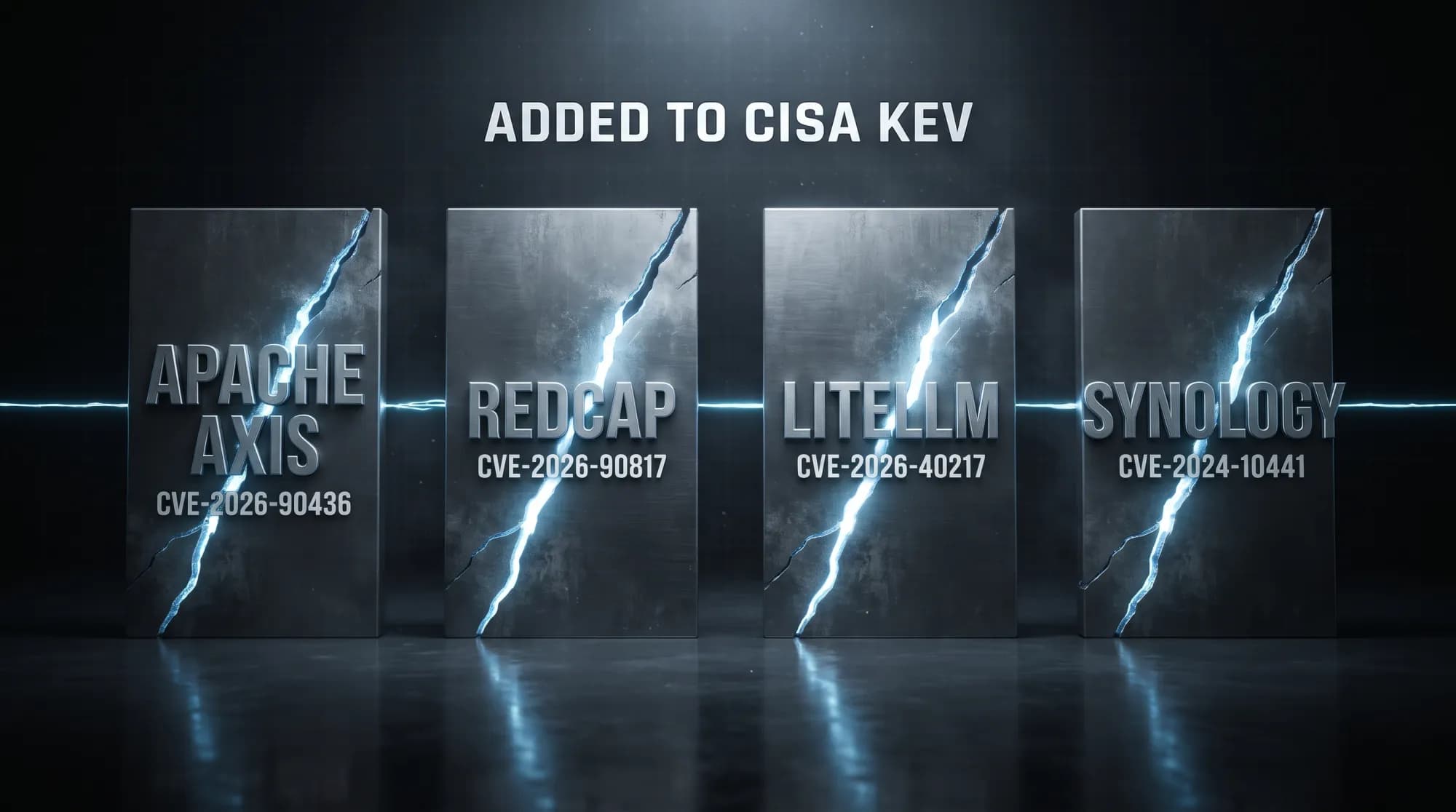
CISA added four CVEs to its Known Exploited Vulnerabilities (KEV) catalog on Nov 18, 2026, and all four lead to remote code execution: Apache Axis 1.x (CVE-2026-90436), Vanderbilt University's REDCap (CVE-2026-90817), BerriAI LiteLLM (CVE-2026-40217) and Synology DiskStation Manager and BeeStation OS (CVE-2024-10441). Three carry a federal due date of Nov 21 and the fourth, LiteLLM, Dec 2.
None of the four is new. Their CVE records were published 12, 59, 222 and 609 days before the KEV listing, and that spread is what this post looks at.
The four at a glance
CVE | Product | Score | EPSS | CVE published | Added to KEV | Due |
|---|---|---|---|---|---|---|
CVE-2026-90436 | Apache Axis 1.x | 9.8 Critical | 1.1% | Nov 6, 2026 | Nov 18 | Nov 21 |
CVE-2026-90817 | REDCap (Vanderbilt University) | 9.8 Critical | 3.7% | Sep 20, 2026 | Nov 18 | Nov 21 |
CVE-2026-40217 | LiteLLM (BerriAI) | 8.8 High | 17.0% | Apr 10, 2026 | Nov 18 | Dec 2 |
CVE-2024-10441 | Synology DSM and BeeStation OS | 9.8 Critical | 1.3% | Mar 19, 2025 | Nov 18 | Nov 21 |
Scores and EPSS are as VulnTracker showed them on Nov 19. The score source differs by row, and two rows have a second score under a different CVSS version, covered below.
Apache Axis 1.x, CVE-2026-90436
The oss-security post of Nov 6 describes it this way: when a SOAP Fault carries a detail/exceptionName element, Axis loads the named class and, if a String data element is also present, instantiates it through its String constructor before checking that it is an AxisFault. Loading alone runs the class's static initializer, so with a suitable class on the application's classpath this leads to remote code execution. The fault is parsed while the engine resolves the target service, before any per-service handler chain runs, so authentication handlers configured on a service do not protect against it.
Axis 1 is end of life, and the project says it does not expect to release an Axis 1.x fix. The advisory offers two ways out: migrate to another SOAP engine such as Axis 2/Java, or build Axis with the source patch. The patch is a commit in the apache/axis-axis1-java repository that stops the fault deserializer from initializing arbitrary classes and accepts only AxisFault subtypes. openSUSE Tumbleweed ships axis 1.4-311.1 or later. The finder is credited as José Apari-Pantigozo of OKIOK.
CISA-ADP scores it 9.8. SUSE scores it 8.1 with attack complexity High. None of the pages I could read says the flaw is exploited, so the KEV listing is the exploitation signal. VulnTracker also lists a CERT-Bund bulletin on several Atlassian products against this CVE. I could not read it, so I do not claim that any particular product bundles Axis.
REDCap, CVE-2026-90817
REDCap (Research Electronic Data Capture) is Vanderbilt University's web platform for research data collection and surveys. The CVE record describes an unauthenticated code injection in its survey passthrough routing and Data Import processing (CWE-94 and CWE-73). A crafted HTTP request from a public survey context reaches a controller route it should not, and a crafted file-path parameter is accepted during import handling.
Securifera's write-up of Sep 27 says the attacker needs only a valid public survey hash, with no account, session or role, and that the hash is not a password. The CVE record says REDCap 13.3.0 and higher is affected. Fixed releases are 16.0.49 LTS, 17.3.10 LTS and 17.4.4 Standard. If you cannot upgrade at once, Securifera suggests restricting or disabling public surveys and blocking survey-context access to the root dispatcher, the Data Import controller and the Parcel controller, as temporary containment. The finder is credited as Ryan Wincey of Securifera.
The record was published on Sep 20. CISA's own enrichment on Sep 21 listed exploitation as "none", and Securifera's post with the proof of concept followed on Sep 27. I found no source that says who is exploiting it. VulnTracker's page shows 7 exploits for it.
LiteLLM, CVE-2026-40217
LiteLLM is an open-source gateway that proxies requests to AI model providers. The X41 D-Sec advisory (X41-2026-001, dated Apr 8) says the proxy's /guardrails/test_custom_code endpoint accepts Python source for guardrail testing and runs it in a restricted environment that relies on regex filtering of the source text. X41 says that filter can be bypassed with bytecode rewriting to get arbitrary code execution, as the LiteLLM process user, which it says is root in the default Docker image.
The flaw is authenticated. X41's workarounds say the endpoint requires the master key, and the CVSS vector has PR:L. Affected is LiteLLM through 2026-04-08, the main-latest image at the time. X41 lists patched versions as TBD and says no vendor patch was available at publication, and I could not find a fixed version in the sources I read. X41 reports finding the issue on Feb 13, 54 days before publication.
X41's workarounds are to deny the endpoint at the reverse proxy, restrict the master key to trusted administrators, keep the admin interface off untrusted networks and run the container as an unprivileged user. Red Hat lists the CVE for Ansible Automation Platform 2.6 and OpenShift AI 3.3, both with fixed builds, and for Lightspeed Core with no fixed version stated. VulnTracker links the GitHub advisory GHSA-wxxx-gvqv-xp7p, "Sandbox escape in custom-code guardrail", published May 7. The list page I read shows no CVE ID, so I cannot confirm that mapping myself.
No source I read says who is exploiting it. CISA's enrichment on Jun 15 listed exploitation as "poc".
Synology DSM and BeeStation OS, CVE-2024-10441
Improper encoding or escaping of output in the system plugin daemon (CWE-116) lets a remote attacker run code through "unspecified vectors", and Synology has not said more. The CVSS vector needs no privileges and no user interaction. Both advisories carry the Pwn2Own 2024 tag and the ZDI-CAN-25403 reference: SA_24_20 covers DSM and SA_24_23 covers BeeStation OS, and both were first published on Nov 5, 2024. The CVE record followed on Mar 19, 2025. MITRE credits Ryan Emmons as the finder.
Fixed builds are DSM 7.2.2-72806-1, 7.2.1-69057-6, 7.2-64570-4 and 7.1.1-42962-7 or later, and BeeStation OS 1.1-65374 or later. Both advisories list the mitigation as "None". The score is 9.8.
Synology's advisories say nothing about exploitation. The CVE record does carry CISA's enrichment, which shows the KEV entry dated Nov 18, 2026 and exploitation marked active. That makes this the one KEV date of the four that I could confirm outside VulnTracker. Nothing I read says who is exploiting it.
From 12 days to 609 days
Product | CVE record published | Days to KEV | Fix situation at listing |
|---|---|---|---|
Apache Axis 1.x | Nov 6, 2026 | 12 | No Axis 1.x release; source patch and openSUSE package |
REDCap | Sep 20, 2026 | 59 | Fixed releases available |
LiteLLM | Apr 10, 2026 | 222 | No fixed version found in the sources I read |
Synology DSM and BeeStation OS | Mar 19, 2025 | 609 | Fixed builds; advisories out since Nov 5, 2024 (743 days) |
A KEV listing marks when exploitation is confirmed, not when a flaw is disclosed, so it can arrive at any point in a CVE's life. CISA's own enrichment shows the move: REDCap read exploitation "none" on Sep 21 and LiteLLM read "poc" on Jun 15, and both now read Active.
The same listing day asks four different things of the same reader. For Synology it means installing an update that has existed for two years. For REDCap it means upgrading to a release that has been out for weeks. For Axis 1.x there is no release to install, only a source patch or a migration. For LiteLLM it means containing an endpoint while a fix, which I could not confirm in the sources I read, is located or awaited.
Reading it on VulnTracker
Each CVE page shows the CVSS score with its source, the EPSS percentage, the KEV added and due dates, and the SSVC decision points. Across the four, exploitation is Active on every page and technical impact is Total. Automatable is Yes for Axis, REDCap and Synology, and No for LiteLLM.
EPSS runs from 1.1% for Axis to 17.0% for LiteLLM, which is higher than 97% of all CVEs. LiteLLM is also the only one of the four that needs authentication, the only one scored High instead of Critical, and the one with the later due date of Dec 2.
A few fields need a second look. Axis is scored 9.8 by CISA-ADP and 8.1 by SUSE. LiteLLM is 8.8 under CVSS 3.1 and 8.7 under CVSS 4.0 in X41's advisory. LiteLLM's weakness type is CWE-420 in the CVE record and CWE-94 in X41's and Red Hat's pages, and VulnTracker shows both. The status field reads Undergoing analysis for Axis and REDCap and Modified for LiteLLM and Synology.
Data notes: KEV dates, EPSS and SSVC come from VulnTracker pages. The MITRE record for Axis and the Apache mailing list thread could not be read, and NVD and CISA pages could not be read directly. VulnTracker dates the Red Hat erratum RHSA-2026:24866 Nov 18, while Red Hat's own page shows it as issued on Jun 9.
What to do
First find out which of the four you run and which are reachable from outside. The due dates below are CISA's deadlines for US federal agencies. For everyone else they are a sensible order.
Due Nov 21: update Synology DSM to 7.2.2-72806-1, 7.2.1-69057-6, 7.2-64570-4 or 7.1.1-42962-7 or later, and BeeStation OS to 1.1-65374 or later. Upgrade REDCap to 16.0.49 LTS, 17.3.10 LTS or 17.4.4 Standard; if you cannot, restrict or disable public surveys and block survey-context access to the root dispatcher, the Data Import controller and the Parcel controller, as Securifera suggests. For Axis 1.x, list every application that bundles an Axis 1 jar, then apply the source patch or move to another SOAP engine. Because Axis parses the fault before service authentication runs, limiting who can reach those SOAP endpoints is worth doing as well; that is my own general advice, not from the Axis advisory.
Due Dec 2: for LiteLLM, deny /guardrails/test_custom_code at the reverse proxy, restrict the master key to trusted administrators, keep the admin interface off untrusted networks and run the container as an unprivileged user, as X41 advises. Check BerriAI's releases for a fix, and apply the Red Hat errata if you run Ansible Automation Platform 2.6 or OpenShift AI 3.3.
Takeaway
Four remote code execution flaws joined KEV on one day, and they were 12 days, 59 days, 222 days and 609 days old. An old CVE record does not mean a closed case: check your inventory against the table above and start with the ones due on Nov 21. Track each CVE's score, EPSS, KEV dates and SSVC on VulnTracker.
References
- CISA Known Exploited Vulnerabilities Catalog
- Apache Axis 1.x advisory on oss-security, Nov 6, 2026
- Apache Axis 1 source patch commit
- SUSE: CVE-2026-90436
- Securifera: REDCap CVE-2026-90817 write-up
- X41 D-Sec advisory X41-2026-001 on LiteLLM
- Red Hat: CVE-2026-40217
- Red Hat: RHSA-2026:24866
- BerriAI LiteLLM security advisories
- Synology advisory SA_24_20 (DSM)
- Synology advisory SA_24_23 (BeeStation OS)
- CVE records on CVE.org: CVE-2026-90436, CVE-2026-90817, CVE-2026-40217, CVE-2024-10441
Related reading
CISA Adds Four Exploited Flaws to KEV: vCenter, Apache Roller, Cisco Expressway and SAP NetWeaver
CISA added flaws in VMware vCenter, Apache Roller, Cisco Expressway and SAP NetWeaver to KEV with a three-day federal deadline. All four have fixes, but the public evidence behind each listing ranges from a full threat report to nothing at all.
CVE-2026-115731: Perforce Puppet RCE Added to CISA KEV 13 Days After the First Exploitation Report
CISA added CVE-2026-115731, a deserialization flaw in Perforce Puppet Server, to KEV on Nov 17, 2026, 13 days after a Reddit post first claimed exploitation. Affected versions, fixed releases, why autosign matters and what to check on your CA.
Exploited CVEs Nov 9-15, 2026: Microsoft, Chrome, Barracuda, Check Point, OpenSSH
Twelve CVEs were added to CISA's KEV catalog from Nov 9 to 15, 2026, including Outlook, Chrome, Barracuda, Check Point and OpenSSH. All twelve are marked exploited, yet eight have an EPSS of 2.2% or lower. Fixes, due dates and what to patch first.